The Silent Revolution: How Smart Restaurants Are Winning in 2025
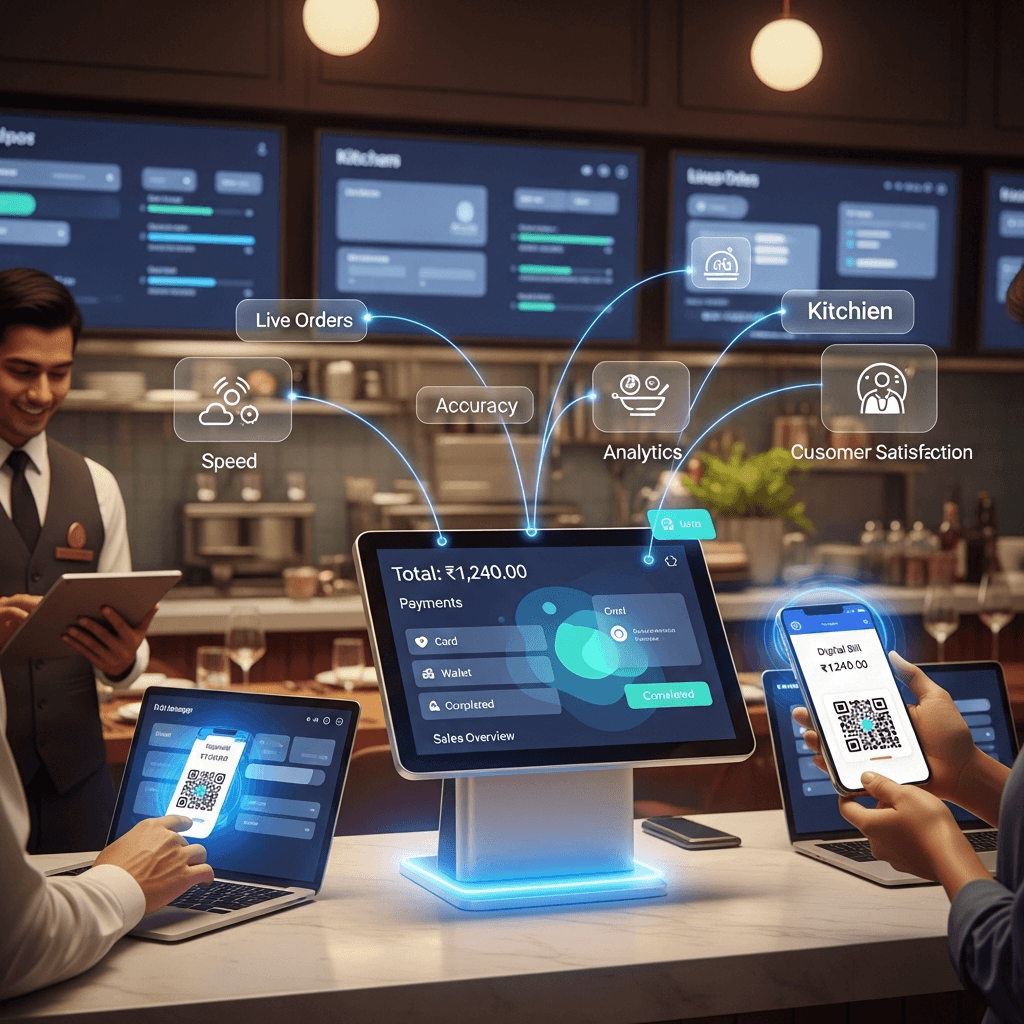
Something remarkable is happening in the restaurant industry. While headlines focus on rising costs and labor shortages, a quieter transformation is reshaping which restaurants thrive and which struggle to survive. The difference isn't luck, location, or even the food itself—it's how intelligently they operate.
Walk into two identical restaurants on the same street. Same cuisine, similar prices, comparable ambiance. Yet one turns tables 40% faster, makes 23% more profit, and has staff that actually stays. The other fights the same battles every dinner rush, watches margins shrink, and wonders what they're missing.
The answer lies in an invisible layer of intelligence that's become the defining competitive advantage in modern hospitality. This isn't about having the fanciest technology or the biggest budget—it's about understanding that the restaurant business has fundamentally changed, and adapting before it's too late.
The New Reality of Restaurant Economics
The numbers tell a sobering story. The average restaurant operates on margins between 3-9%, leaving almost no room for error. A single inefficient process—whether it's order mistakes, slow table turns, or poor scheduling—can be the difference between profitability and closure.
of restaurants fail within the first year
average annual cost of order errors per restaurant
revenue lost to operational inefficiency
Yet within this challenging landscape, a distinct category of restaurants is not just surviving but thriving. They're not necessarily the ones with celebrity chefs or prime locations. They're the ones who've recognized that running a restaurant in 2025 requires a fundamentally different approach than it did even five years ago.
The insight: Top-performing restaurants don't work harder—they work with better information. They know exactly which dishes drive profit, which time slots need more staff, and which customers are likely to return. This intelligence isn't a luxury; it's the foundation of sustainable success.
The Three Pillars of Restaurant Intelligence
After analyzing patterns across hundreds of successful restaurants, three consistent differentiators emerge. These aren't about technology for technology's sake—they're about solving the core challenges that have always plagued the industry.
1. Speed Without Sacrifice
The relationship between speed and quality has traditionally been adversarial. Move faster, make more mistakes. Slow down, frustrate customers. The best restaurants have broken this false dichotomy.
Consider the dinner rush. In a traditional setup, orders flow from server to kitchen through a chain of potential failure points—handwriting misread, ticket lost, timing miscommunicated. Each friction point costs time and creates errors. The average restaurant loses 12 minutes per table to these inefficiencies alone.
Smart restaurants have eliminated these friction points entirely. Orders flow instantly from customer to kitchen, displayed clearly on screens that prioritize by timing and complexity. The result? Faster service, fewer errors, and kitchens that can handle 30% more volume without additional stress.
This is exactly why we built FinixoDine's Lightning Fast POS—processing orders in milliseconds with an optimized touch interface, paired with our Kitchen Display System that ensures every ticket reaches the right station in the right sequence. No more lost orders. No more shouting across the kitchen.
“The restaurants winning today aren't the ones trying to do more—they're the ones who've eliminated everything that slows them down.
2. Visibility Into What Actually Matters
Most restaurant owners operate with dangerous blind spots. They know their total revenue but not their profit per dish. They sense which nights are busy but can't predict demand accurately. They feel like certain staff perform better but lack the data to prove it.
This lack of visibility leads to costly decisions based on intuition rather than insight:
Menu pricing based on food cost alone, missing the contribution margin picture
Staff scheduling that either bleeds labor costs or leaves rushes understaffed
Inventory ordering that results in waste or stockouts
Marketing spend without understanding which efforts actually drive returns
The alternative is restaurants that operate with complete visibility. They know in real-time which dishes are selling, which tables need attention, and how today's performance compares to last week. They spot problems before customers complain and opportunities before competitors notice.
FinixoDine's Smart Analytics puts this visibility at your fingertips—deep insights into sales trends, customer preferences, and operational patterns. Know your Stars and Dogs. Understand your peak hours down to 15-minute intervals. Make decisions based on data, not guesswork.
3. Customer Experience That Scales
There's a fundamental tension in hospitality: personal attention creates memorable experiences, but personal attention doesn't scale. The more successful a restaurant becomes, the harder it is to maintain the intimacy that made it successful in the first place.
Leading restaurants have solved this by being intelligent about where human touch matters most. They've automated the transactional moments—ordering, payment, basic inquiries—so staff can focus on the moments that actually build loyalty: recommendations, problem resolution, genuine connection.
| Traditional Approach | With FinixoDine |
|---|---|
| Staff tied up taking orders | QR Ordering lets guests order when ready |
| Customers wait for the check | Integrated Payments—pay anytime, any method |
| Reservations managed in notebooks | Smart Reservations with auto-confirmations |
| No insight into guest satisfaction | Real-time feedback and ratings |
| Staff scheduling via WhatsApp chaos | Staff Management with shift tracking |
The Economics of Excellence
What does this intelligent approach actually mean for the bottom line? The numbers are compelling:
Reduced order errors save the average restaurant ₹3-5 lakhs annually in wasted food and comped meals. Beyond the direct costs, fewer mistakes mean fewer frustrated customers and better reviews—the compounding value is difficult to quantify but impossible to ignore.
Faster table turns increase capacity without increasing real estate. A restaurant that reduces average dining time by just 10 minutes can serve an additional 15-20% more covers during peak hours. That's significant revenue from the same fixed costs.
Optimized scheduling eliminates both the waste of overstaffing and the service degradation of understaffing. Restaurants typically find 10-15% labor savings while simultaneously improving service quality—a rare instance where cost reduction and customer experience move in the same direction.
Data-driven menu engineering shifts the product mix toward higher-margin items without customers noticing. A 2% improvement in average margin might sound modest until you calculate what it means across thousands of orders annually.
The compounding effect: Each efficiency gain enables others. Faster service means more covers. More covers means more data. Better data enables smarter decisions. Smarter decisions improve every subsequent metric. Restaurants that embrace this cycle early build advantages that become increasingly difficult for competitors to match.
The Customer Perspective Shift
Something fundamental has changed in how customers evaluate restaurants. The post-pandemic diner has higher expectations for both experience quality and operational competence. They notice when things work smoothly—and they definitely notice when they don't.
QR-based ordering, once seen as an impersonal shortcut, has been reframed. Customers now appreciate the control: ordering when ready, exploring the menu without pressure, paying without flagging down staff. What matters isn't the mechanism but the outcome—feeling respected and in control of their experience.
Similarly, the visible indicators of a well-run operation—food arriving promptly, staff appearing calm rather than frantic, bills arriving before they're requested—have become part of the overall experience evaluation. Operational excellence is no longer invisible back-office work; it's part of what customers are paying for.
“Today's diners don't just evaluate the food—they evaluate how intelligently the entire experience is orchestrated.
How FinixoDine Powers This Transformation
We built FinixoDine to be the operating system for modern restaurants—everything you need, working together seamlessly, from kitchen to cloud.
Lightning Fast POS
Process orders in milliseconds. Intuitive touch interface designed for the chaos of peak hours.
Kitchen Display System
Real-time order routing to the right stations. Track timing. Eliminate paper tickets forever.
QR Ordering
Guests order from their phones. Reduce wait times. Increase average order value.
Smart Analytics
Deep insights into sales, trends, and customer preferences. Data-driven decisions made simple.
Staff Management
Schedule shifts, track performance, manage permissions—all in one place.
Integrated Payments
Accept every payment method. Split bills effortlessly. Manage tabs with ease.
The Path Forward
The restaurants that will thrive in the coming years share a common characteristic: they treat operational intelligence as a core competency rather than an afterthought. They understand that the old model—great food, friendly service, prime location—is necessary but no longer sufficient.
This doesn't mean abandoning what makes restaurants special. The warmth of hospitality, the craft of cooking, the art of creating memorable moments—these remain central. But they're now built on a foundation of intelligent systems that handle the complexity, freeing humans to do what humans do best.
The silent revolution isn't about technology replacing tradition. It's about technology enabling tradition to scale without losing its soul. The restaurants that understand this distinction are the ones writing the next chapter of the industry.
The question for every restaurant owner is simple: which side of this transformation will you be on?
Ready to Transform Your Restaurant?
See how FinixoDine can streamline your operations, delight your customers, and grow your revenue—with a personalized demo.
No commitment required • Get started in minutes • Plans from ₹4,100/month